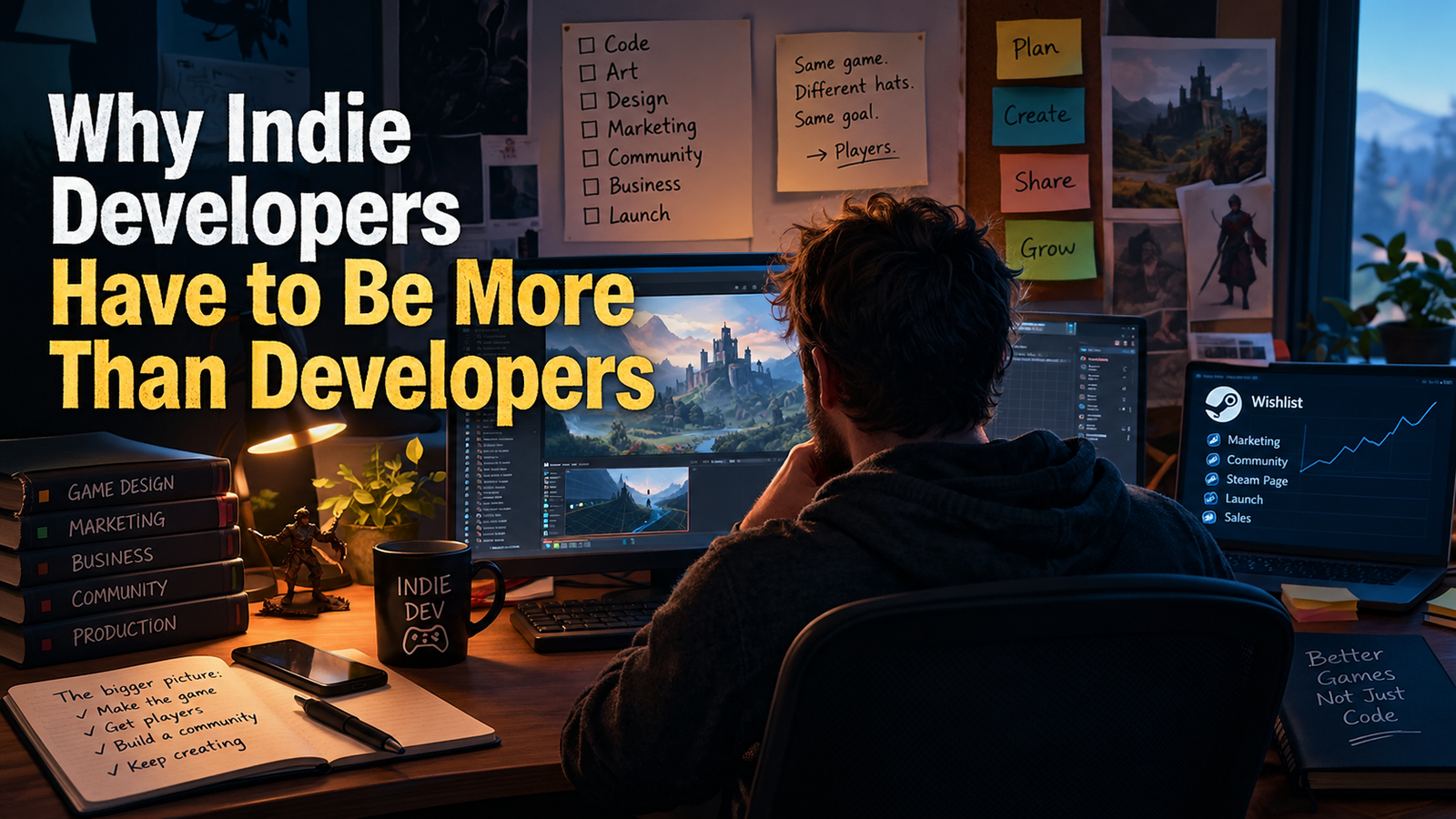
When someone decides to make an indie game, they usually start by thinking about the most exciting part: making the game.
Programming the systems. Creating the characters. Building the world. Making the combat work. Creating that mechanic that has been in your head for months.
And obviously, that is a huge part of the job.
But there is a problem.
Making the game is only one part of being an indie developer.
At some point, you need to figure out how to present the game, find players, create a Steam page, make a trailer, produce screenshots, manage a community, understand your numbers, think about money, and eventually try to sell something you’ve spent months or years building.
And that’s when many developers discover that being good at development doesn’t necessarily mean being good at making an indie game succeed.
The Indie Developer Doesn’t Have a Department for Everything
In a large studio, there are people specialized in almost everything.
There are programmers.
Designers.
Artists.
Animators.
Level designers.
Technical artists.
Producers.
Marketing teams.
Community managers.
QA.
People responsible for press relations.
People responsible for publishing.
People responsible for business.
And many other roles.
An indie developer usually doesn’t have any of that.
Sometimes you have a small team. Sometimes you have an artist working with you. Sometimes you hire someone for a specific task.
But especially in the beginning, there is one person who needs to look at almost everything.
You.
Programming Is Only One Part
Imagine that you’ve spent two years creating a game.
The game works.
The systems are working.
The combat is fun.
The graphics look good.
You’ve fixed the most important bugs.
Finally, it’s time to put the game on Steam.
And then a question appears:
How is anyone going to discover that your game exists?
That question can’t be answered with code.
You may have written thousands of lines of C++ or C#.
You may have created a fantastic architecture.
You may have developed an extremely sophisticated AI system.
None of that guarantees that someone will click on your game’s store page.
The player first needs to find the game.
Then they need to be interested in it.
Then they need to understand what it is.
And finally, they need to decide:
“I want to play this.”
That’s marketing.
Marketing Isn’t a Dirty Word
There is a certain resistance among developers when the subject of marketing comes up.
I understand that.
We like building things.
Marketing feels like something completely different.
But marketing, especially for an indie developer, doesn’t have to mean aggressive advertising or trying to convince someone to buy something they don’t want.
At its core, marketing is communication.
You’re trying to answer some very simple questions:
What is my game?
Why should someone be interested in it?
Who is this game made for?
How do I reach those people?
If you can’t answer those questions, there’s a good chance that nobody will understand what you’re trying to sell.
Steam Isn’t a Sales Machine
One of the biggest misconceptions a developer can have is thinking that putting a game on Steam means putting it in a store and waiting for sales.
It doesn’t work that way.
Steam has thousands of games.
Your game is competing for the player’s attention with games from major studios, other indies, games that already have huge communities, and, most importantly, all the other games being released at that moment.
Having a Steam page doesn’t mean people will find it.
You need to bring people to it.
And even before that, you need to make those people want to click.
That’s why things like capsule art, screenshots, trailers, descriptions, and wishlists are so important.
The game can be excellent.
But if the presentation doesn’t communicate that, the player may simply move on to the next game.
You Also Need to Understand Art
That doesn’t mean every indie programmer needs to become a professional artist.
But you need to learn enough to work with art.
You need to understand enough to evaluate an asset.
You need to know whether an image works for a particular purpose.
You need to be able to communicate with an artist.
You need to understand what can and cannot be produced within your budget.
And when you don’t have the money to hire someone, you may need to do some things yourself.
The same applies to audio.
You don’t necessarily need to become a composer or sound designer.
But you need to understand how these areas influence the game and know how to find professionals or resources that can fill those gaps.
You Need to Understand Business
This may be one of the most uncomfortable parts.
A game is a creative work.
But developing a commercial game is also a business.
You need to think about costs.
How much will it cost to produce the game?
How long can you afford to work on it?
How much do you need to spend on art?
How much can you spend on marketing?
What will the price be?
Is there a large enough audience?
Can the game recover the investment?
Do you need a publisher?
Investment?
Can you finance the project yourself?
These questions don’t make the game less artistic.
They help determine whether you’ll be able to keep making games after this project.
And Then There’s the Community
Today, developing a game also means building some kind of relationship with the people who might play it.
Discord.
YouTube.
Reddit.
X.
TikTok.
Steam.
And other platforms.
You don’t need to be on all of them.
In fact, trying to be everywhere can be a terrible idea.
But you need to find the places where your audience is.
And you need to learn how to talk to those people.
Show the development process.
Share updates.
Get feedback.
Show problems.
Show progress.
And, most importantly, build interest before launch.
A small community that is genuinely interested in your game can be much more valuable than thousands of people who simply saw an advertisement once.
The Developer Also Becomes the Producer
Another role that naturally appears in indie projects is producer.
When you work alone, nobody is telling you what needs to be done tomorrow.
You have to decide.
Which feature comes first?
What can wait?
What needs to be cut?
What’s delaying the project?
What’s the next milestone?
How long should a particular task take?
And perhaps the hardest question:
Does this feature really need to exist?
It’s very easy to add things to a game.
It’s much harder to decide what not to do.
The Danger of Trying to Do Everything
There is a downside to this need to be “more than a developer.”
You can end up trying to do absolutely everything.
Programming.
Modeling.
UI.
Video editing.
Creating thumbnails.
Writing posts.
Managing Discord.
Doing marketing.
Answering players.
Studying analytics.
Managing the Steam page.
And still trying to develop the game.
At some point, you may realize that you’ve spent more time promoting the game than developing it.
That’s why being an indie developer doesn’t necessarily mean doing everything yourself.
It means understanding everything well enough to know what needs to be done, what you can do yourself, and what should be delegated.
You Don’t Need to Be an Expert at Everything
This may be the most important part.
You don’t need to be an excellent programmer, artist, designer, writer, musician, producer, marketer, and entrepreneur at the same time.
That would be practically impossible.
What you need is a broader understanding of the project.
If you’re a programmer, learn enough about marketing to understand how your game will be presented.
Learn enough about design to understand the experience you’re building.
Learn enough about art to communicate with your artists.
Learn enough about business to understand the numbers.
And when you find an area you’re not good at, get help.
That help might come from a professional.
It might be a partner.
It might be a publisher.
It might be a tool.
Or it might simply be knowledge that you still need to acquire.
The Internet Has Also Changed What’s Possible
There is a huge advantage for indie developers today.
We have access to tools that would have been unimaginable for a small team a few decades ago.
Free or affordable game engines.
Asset stores.
Editing tools.
AI.
Backend services.
Distribution platforms.
Social media.
Analytics tools.
Communities.
Tutorials.
Documentation.
And even tools that allow a single person to produce things that once required an entire team.
That doesn’t mean making games has become easy.
In fact, perhaps the opposite has happened.
It’s become easier to create games, but much harder to get people to pay attention to them.
And that difference is extremely important.
The Indie Developer Needs to Think of the Game as a Product
I know the word “product” can be uncomfortable when we’re talking about something creative.
But there’s a difference between saying that a game is only a product and understanding that it also needs to work as a product.
You can create something deeply personal.
It can be an artistic experience.
It can tell a story that means a lot to you.
But if you intend to sell that game, you need to find a way to communicate its value to other people.
The player wasn’t inside your head for the last two years.
They don’t know how much work you put into that system.
They don’t know how many nights you spent fixing that bug.
They don’t know that a tiny animation took three days to get right.
They only see the result.
And that result needs to convince them.
Being Indie Means Being Adaptable
Perhaps this is the most important characteristic an indie developer needs to have.
Adaptability.
You may start a project thinking you’re going to make one thing and end up making something completely different.
You may discover that a particular mechanic doesn’t work.
You may realize that your audience is different from what you expected.
You may discover that you need to change your marketing strategy.
You may need to learn a new tool.
You may need to hire someone.
You may need to cut a feature you loved.
And all of that is part of the process.
Being independent doesn’t mean having absolute control over everything.
It means having the freedom — and the responsibility — to make those decisions.
In the End, You’re Still a Developer
After all of this, there’s a risk of forgetting why we started.
In the middle of marketing, numbers, Steam, community, budgets, and production, there’s still the original reason:
making games.
It’s important not to lose that.
Because you can learn marketing.
You can learn business.
You can learn production.
You can learn how to build a community.
You can learn how to analyze data.
But all of these things exist to help you put the game you’re creating into the hands of players.
Being an indie developer means much more than writing code.
It means understanding the project as a whole.
Sometimes you’ll be a programmer.
Sometimes a designer.
Sometimes a producer.
Sometimes an artist.
Sometimes a salesperson.
Sometimes technical support.
And on some days, you’ll probably be all of those things before lunch.
But maybe that’s exactly what makes being indie so interesting.
You’re not just developing a game.
You’re building something from beginning to end.
And the more you understand each part of that process, the better your chances of turning an idea into something that actually reaches players.