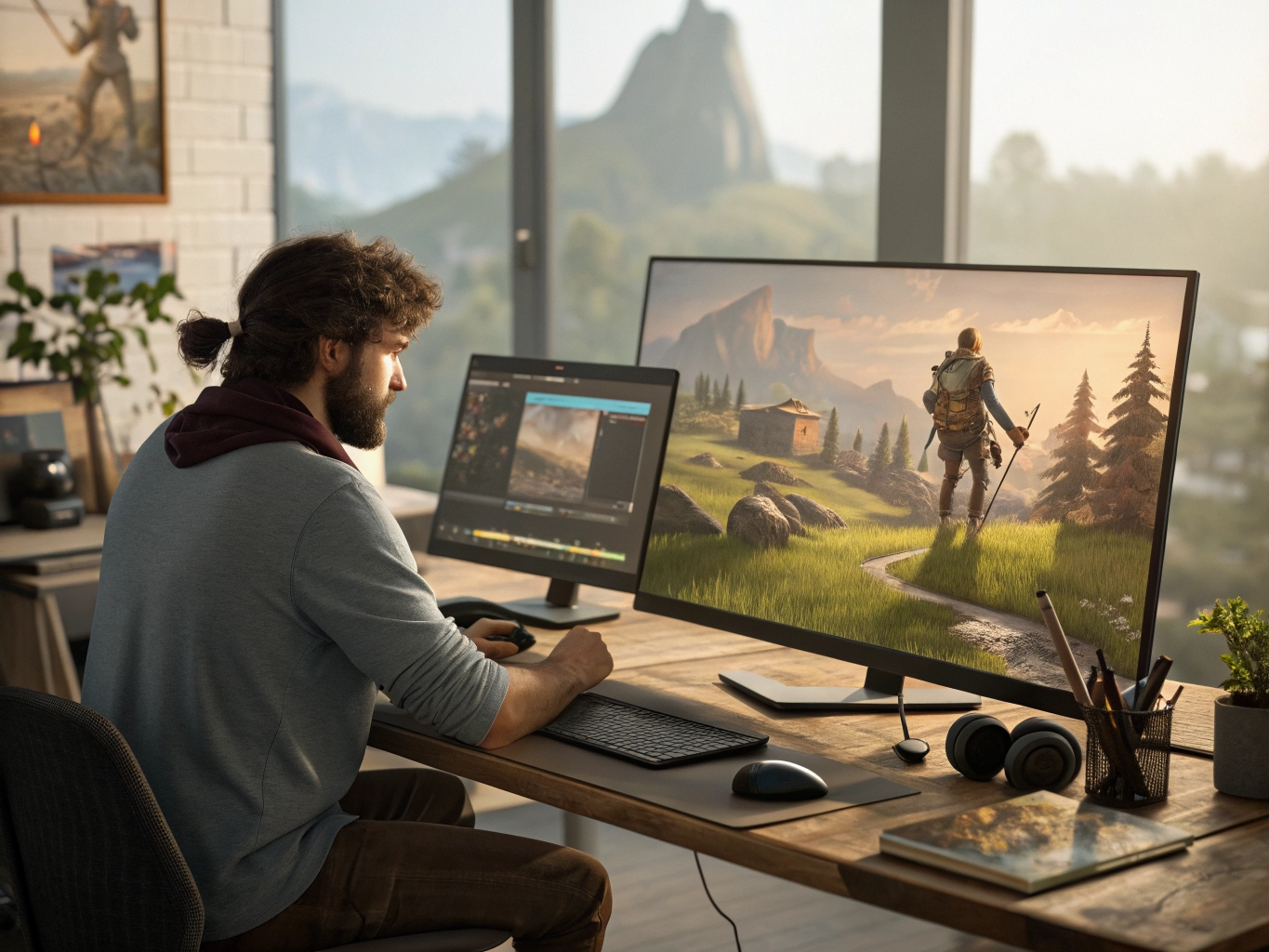
When people think about game development, programmers and game designers are often the first professionals who come to mind. But there is another role that is just as important in creating the worlds we play in: the 3D artist.
Without 3D artists, there would be no characters, environments, buildings, weapons, vehicles, creatures, or countless other elements that make a game world feel alive.
But what does a career as a 3D artist actually look like?
What Does a 3D Artist Do?
The term “3D artist” covers a much broader range of responsibilities than it might seem.
In a large studio, artists are often highly specialized. You may have character artists working exclusively on characters, environment artists creating landscapes and buildings, vehicle artists, texture and material artists, lighting artists, riggers, animators, VFX artists, and technical artists.
In a smaller studio or as a freelancer, however, one person may be responsible for several of these tasks.
A single artist might model a character, create its textures and materials, prepare it for animation, create the necessary LODs, set up collisions, and then integrate everything into Unreal Engine or Unity.
This is one of the things that makes a career in game art so interesting: there are many different directions you can take.
Modeling Is Only the Beginning
One of the biggest misconceptions about 3D art for games is that knowing how to model is enough.
It isn’t.
A model that looks great inside a 3D modeling application can still be completely unsuitable for a game.
Game assets have technical requirements. Polygon counts matter. Topology matters. UVs matter. Textures and materials matter. LODs matter. Collision matters. Performance matters.
The artist needs to understand how the asset will actually be used inside the game.
A beautiful character with millions of unnecessary polygons may look impressive in a portfolio, but if it cannot run efficiently in the target game, it becomes a problem rather than a solution.
This is why game artists benefit from understanding the technology behind the art.
Understanding the Engine
A good game artist doesn’t necessarily need to become a programmer, but understanding how a game engine works can make a huge difference.
Knowing how assets behave inside Unreal Engine or Unity helps artists make better decisions.
Understanding materials, textures, lighting, shaders, LODs, animation systems, and asset pipelines makes communication with programmers and technical artists much easier.
And the better that communication becomes, the easier it is for the entire team to work together.
Game development is rarely about one discipline working independently. The best results usually happen when artists, designers, programmers, and other professionals understand at least a little about each other’s work.
Your Portfolio Matters More Than Your Tool List
For someone trying to build a career as a 3D artist, the portfolio is one of the most important things they can have.
Knowing Blender, Maya, 3ds Max, ZBrush, Substance Painter, or another tool is useful, but simply listing software on a résumé doesn’t demonstrate what you can actually produce.
A portfolio does.
Studios want to see the quality of your work and, more importantly, whether your work matches the type of content they need.
A strong portfolio doesn’t necessarily need dozens of models.
A few excellent pieces can be much more effective than a huge collection of unfinished or inconsistent work.
The portfolio should answer a simple question:
Can this person create the kind of art we need?
Specialist or Generalist?
Another important decision for a 3D artist is whether to specialize or become a generalist.
A character artist can spend years learning anatomy, sculpting, facial details, hair, clothing, and character production.
An environment artist may focus on architecture, landscapes, vegetation, props, composition, and world building.
A technical artist may work at the intersection between art and programming, solving problems involving shaders, tools, pipelines, optimization, and rendering.
A generalist, on the other hand, may be comfortable working across several areas.
There isn’t a single correct path.
Specialization can make you extremely valuable in a particular area, while being a generalist can make you more adaptable, especially in smaller teams.
The right choice depends on the kind of work you want to do and the kind of studio you want to work with.
A Changing Market
Like programming, 3D art is changing quickly.
New tools appear constantly. Game engines become more powerful. Rendering technology improves. Production pipelines evolve. Artificial intelligence is becoming part of the creative process.
This can be intimidating, especially for someone starting a career.
But the fundamentals haven’t disappeared.
Learning how to observe, understand proportions, work with lighting, study references, build good topology, create materials, and solve visual problems remains valuable regardless of which software is popular five years from now.
Tools change.
Fundamentals last much longer.
Will AI Replace 3D Artists?
This is probably one of the biggest questions for anyone considering a career in digital art today.
AI can already generate impressive images, concepts, textures, and even some forms of 3D content.
But creating a usable game asset is more complicated than generating something that looks good.
A game character needs appropriate topology. It needs to work with animation. Its materials need to behave correctly. Its scale needs to make sense. It may need several levels of detail. It needs collision. It needs to fit the game’s visual style and production pipeline.
And eventually, someone has to make decisions about all of those things.
AI will certainly change how artists work. It may automate some tasks and make other tasks significantly faster.
But I don’t believe that this means the end of 3D artists.
I believe it means that artists will have another tool.
And, as with many other technologies, the people who understand both the tool and the underlying craft will probably have the biggest advantage.
Learning Never Really Stops
A career in 3D art requires continuous learning.
There will always be another technique to learn, another rendering feature to understand, another workflow to improve, or another tool that becomes useful.
This can sometimes feel exhausting.
But it is also one of the best parts of working in this industry.
You can look at work you created five years ago and immediately see how much you’ve improved.
The important thing is not to try to learn everything at once.
Pick something, practice it, create something with it, and then move to the next challenge.
Learning to Work With Feedback
Art is subjective, and that makes feedback especially important.
An artist can spend days or weeks working on something and become attached to it. Then someone on the team points out a problem that the artist hadn’t noticed.
That can be frustrating.
But learning how to receive criticism is an important part of becoming a professional artist.
The goal isn’t to defend every decision.
The goal is to understand whether the feedback helps make the final product better.
Sometimes the feedback will be right.
Sometimes it won’t.
Learning to tell the difference is part of the job.
There Is More Than One Kind of Artist
One of the great things about game development is that there isn’t a single definition of what a game artist should be.
Some people love creating characters.
Others would rather spend their entire career building environments.
Some are fascinated by materials and shaders.
Others love animation.
Some enjoy solving technical problems more than creating the art itself and eventually move toward technical art.
There are many paths.
And sometimes your career will move between them.
You don’t necessarily have to decide exactly what you want to do for the next twenty years before starting.
Building a Career Takes Time
Like most careers in game development, becoming a professional 3D artist takes time.
You need to learn the tools, but you also need to develop your eye.
You need to understand references, proportions, composition, lighting, materials, and visual storytelling.
You need to learn how to iterate.
And, perhaps most importantly, you need to actually start creating things.
Don’t wait until you believe your work is “good enough” to create a portfolio.
Create the portfolio while you’re learning.
Your first pieces won’t be your best work. That’s normal.
The important thing is that the next piece is better than the previous one.
The Future of 3D Art
The future of 3D art will probably look very different from the past.
AI will become more capable. Game engines will continue to improve. Rendering will become more advanced. More parts of the production pipeline will become automated.
But games will still need people who understand visual communication.
Someone still needs to decide what a world should look like.
Someone needs to decide whether a character feels right.
Someone needs to understand why a scene doesn’t work and how to fix it.
Technology can help create the content.
But deciding what should exist in the first place is a very different problem.
Creating Worlds, Not Just Models
A career as a 3D artist is a combination of art and technology.
You aren’t simply creating models.
You’re helping create worlds.
Every building, character, weapon, creature, environment, and visual effect contributes to the experience the player will have.
That is what makes game art so interesting to me.
The final result isn’t just an image or a model sitting inside a modeling application.
It becomes part of something interactive.
Players walk through it, fight in it, explore it, remember it, and sometimes spend hundreds of hours inside the worlds that artists helped create.
And that’s a pretty good reason to consider a career in 3D art.